
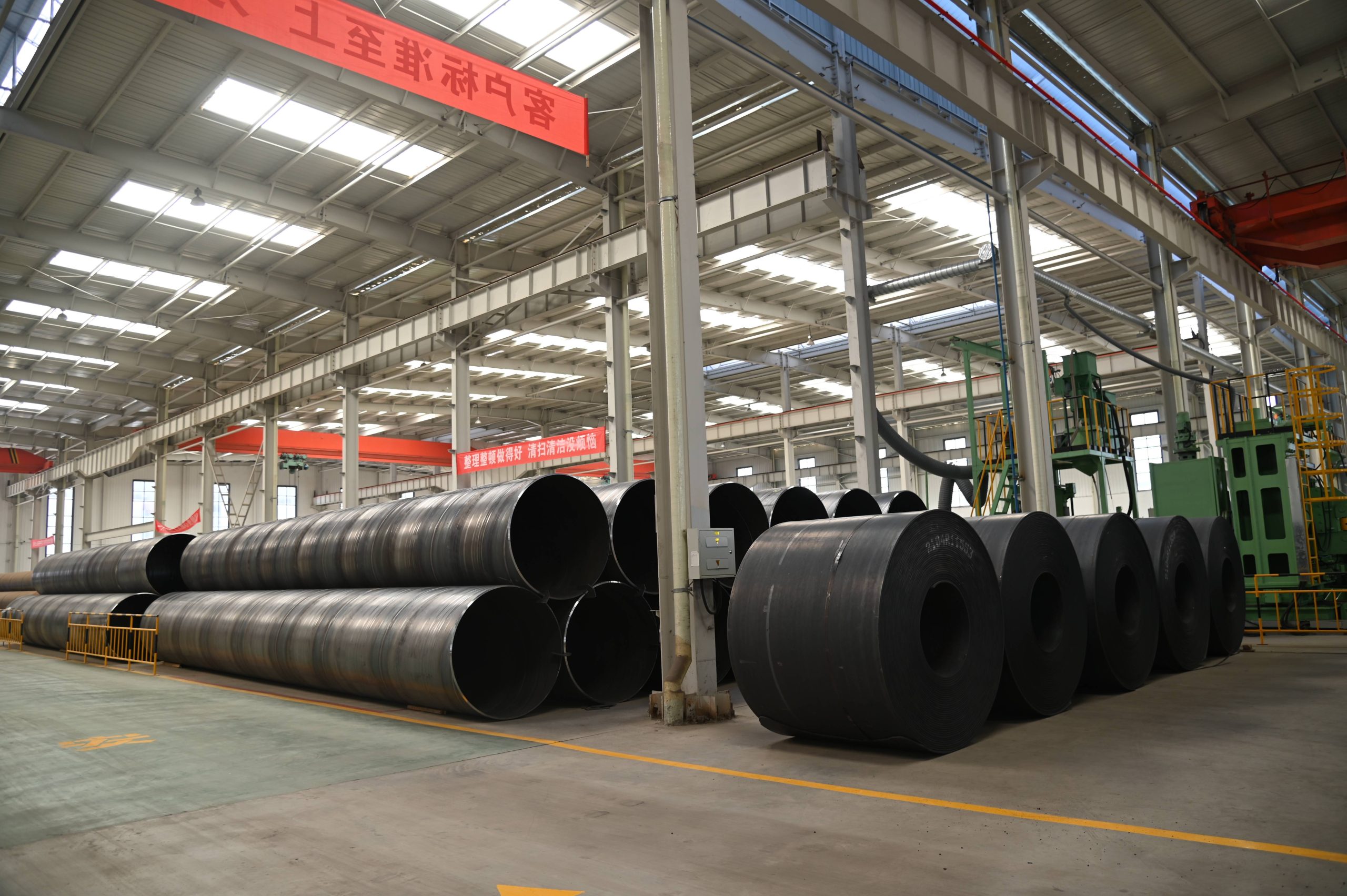
The Large Diameter Spiral Welded Steel Pipe represents a pinnacle of efficient and scaled engineering within the infrastructure of global energy and water transport, a highly specified product whose technical identity is intrinsically linked to the SSAW (Spiral Submerged Arc Welded) manufacturing process, an ingenious method that allows the creation of immense pipe sections—with Outer Diameters ranging from $219 \text{ mm}$ up to $2032 \text{ mm}$ and Wall Thicknesses extending from $5.0 \text{ mm}$ to $20 \text{ mm}$ for standard product lines—from continuous steel coil rather than discrete plates. This technical choice is a profound economic driver, optimizing material utilization and production throughput for high-volume projects, yet it simultaneously introduces a unique set of metallurgical and geometric challenges that must be meticulously managed under the rigorous certification umbrella of standards like API 5L, ensuring that this cost-effectiveness is never achieved at the expense of structural integrity and safety. The pipe’s ability to safely convey critical fluids, whether it is carbon steel pipe for oil and gas or high-volume water, is therefore a direct function of the precise control exerted over the $\text{SAW}$ process, the material’s carefully selected chemistry (encompassing international grades such as Grade B, $\text{X46}$, $\text{X52}$, $\text{Q355}$, $\text{St52}$, and $\text{S355}$), and the comprehensive array of non-destructive testing ($\text{NDT}$) methods applied to verify the integrity of the helically winding weld seam.
The heart of this large diameter pipe is the **Submerged Arc Welding ($\text{SAW}$) ** process itself, a high-energy, high-deposition technique essential for achieving the required wall thickness penetration and structural continuity. The spiral formation, which utilizes continuous coil steel (often hot rolled, as referenced by the Technique hot rolled data) that is uncoiled, edge-prepared, and then fed through a series of rollers to impart the precise helical angle, mandates that the welding occurs simultaneously both internally and externally. This is achieved by flooding the arc with a granulated flux, which generates a protective gaseous envelope and deposits a substantial, high-quality weld metal volume that fuses the bevel-treated edges of the strip. The high heat input associated with $\text{SAW}$ means that the resulting **Heat Affected Zone ($\text{HAZ}$) ** and the weld metal itself possess distinct microstructures compared to the parent material, requiring careful calibration of the process parameters—arc voltage, current, travel speed—to ensure that the weld joint achieves the specified minimum strength ($\text{SMYS}$) and, critically, possesses adequate fracture toughness, a property often verified via Charpy V-Notch testing to guarantee the pipe’s resistance to brittle crack propagation, especially when the pipe is specified for low-temperature service environments.
The technical diversity in the Material selection is crucial, reflecting the global application and varied performance requirements of this $\text{SSAW}$ pipe. While the $\text{API 5L}$ grades—from the foundational Grade B ($\text{SMYS} = 35 \text{ ksi}$) up to the micro-alloyed, high-strength grades like $\text{X52}$ ($\text{SMYS} = 52 \text{ ksi}$) —establish the primary strength envelope for oil and gas transport, the inclusion of non-$\text{API}$ standards such as the Chinese $\text{Q235}$ and $\text{Q355}$ and the European $\text{St37}$, $\text{St52}$, $\text{S235}$, and $\text{S355}$ indicates a convergence under the $\text{API 5L}$ quality system for projects outside of pure hydrocarbon transmission, often for large-scale water or slurry pipelines. The crucial element here is the Chemical Composition, which must be meticulously controlled regardless of the base standard. For the higher-strength $\text{X}$ grades and equivalents like $\text{Q355}$ or $\text{S355}$, the **Carbon Equivalent ($\text{CEq}$) ** is a paramount metric, deliberately kept low through the controlled use of micro-alloying elements (niobium, vanadium) to ensure optimal field weldability and to mitigate the risk of hydrogen-induced cold cracking in the $\text{HAZ}$, a technical necessity given the demanding schedules and often unpredictable conditions of large pipeline construction sites.
The $\text{SSAW}$ geometry introduces a non-trivial complexity to the structural analysis: the weld seam is helical, running at an acute angle to the pipe axis. This geometric configuration means that the weld joint is simultaneously subjected to both the pipe’s primary hoop stress (circumferential tension from internal pressure) and the longitudinal stress (axial tension from pressure, thermal expansion, and external loads), unlike the $\text{LSAW}$ weld which is primarily loaded by hoop stress. This complex stress field mandates extreme confidence in the integrity of the $\text{SAW}$ seam, necessitating the rigorous, $\text{API 5L}$-mandated Non-Destructive Testing ($\text{NDT}$) regimen. The comprehensive quality assurance package includes $100\%$ Ultrasonic Testing ($\text{UT}$ test) of the entire weld volume to detect planar defects (lack of fusion), supplemented by Radiographic Testing ($\text{RT}$ test)—often digital $\text{X-ray}$—to detect volumetric defects like porosity or inclusions, a dual-layer inspection strategy that ensures the high-volume weld is demonstrably free of flaws that could initiate fatigue or rupture under the complex service stresses. Furthermore, the integrity is conclusively proven by the mandatory Hydrostatic test, where every pipe length is proof-tested to a pressure well above its design working pressure, a final mechanical screen that validates the pipe’s pressure containment capability and structural resilience. .
Beyond the core structural material, the functional longevity of the $\text{Large Diameter Spiral Welded Steel Pipe}$ is dependent on the advanced Surface treatment applied to protect it from environmental degradation, a critical factor for buried pipelines. The external coating is the first line of defense against soil corrosion, and the specification offers several high-performance options: 3PE (3-Layer Polyethylene), which provides exceptional mechanical protection and dielectric strength for long-term cathodic protection performance; bitumen (asphalt), a traditional, cost-effective water-resistant barrier; and epoxy powder (often $\text{FBE}$, Fusion Bond Epoxy), prized for its exceptional adhesion and resistance to cathodic disbondment. Similarly, internal coatings—such as Epoxy, bitumen, or cement lining—are essential for reducing internal corrosion when transporting fluids like water or moist gas, or, critically, to reduce the hydraulic roughness coefficient (Hazen-Williams $\text{C}$-factor), thereby minimizing the frictional head loss and the long-term pumping costs associated with massive fluid throughput, a technical requirement that transforms the raw steel pipe into an optimized flow conduit.
The overall quality assurance is encapsulated in the provision of the MTC (Mill Test Certificate), which serves as the auditable record of the pipe’s compliance across all specified parameters—from the initial ladle chemistry of the steel to the final results of the hydrostatic test and the $\text{NDT}$ reports. This certification, governed by the rigorous traceability and documentation standards of API 5L, is the client’s ultimate guarantee, confirming that the pipe, whether specified for high-strength $\text{X52}$ service or general $\text{St37}$ application, has undergone every required mechanical, chemical, and non-destructive test to confirm its fitness for purpose as a critical piece of infrastructure, ensuring that the final product, delivered with its required Bevel for easy field welding, is ready for immediate deployment and decades of reliable service.
Structured Technical Specification Data: Large Diameter Spiral Welded Steel Pipe (SSAW)
| Parameter Category | Technical Requirement/Range | Governing Standards & Certifications | Technical Significance |
| Commodity Name | Pipeline Welding Pipe | $\text{API 5L}$ is the primary line pipe certification. | Product is optimized for fluid transmission service, demanding high integrity. |
| Technique | SSAW (Spiral Submerged Arc Welded) | $\text{SAW}$ welding process (high heat input, high deposition rate). | Economical method for manufacturing Large Diameter pipes ($\text{OD} 219 \text{ – } 2032 \text{ mm}$) from coil steel. |
| Outer Diameter (OD) | $\mathbf{219 \text{ mm} \text{ – } 2032 \text{ mm}}$ | $\text{API 5L}$ and $\text{ASME B36.10M}$ dimensional standards. | Large diameter ensures maximum volumetric flow capacity for high-volume projects. |
| Wall Thickness (WT) | $\mathbf{5.0 \text{ mm} \text{ – } 20 \text{ mm}}$ | Determined by design pressure (Barlow formula) and external loading constraints. | Provides the required structural strength and material allowance for pressure containment and bending resistance. |
| Material Grades | $\text{Grade B}$, $\text{X42}$, $\text{X46}$, $\text{X52}$, $\text{St37}$, $\text{St52}$, $\text{Q235}$, $\text{Q355}$, $\text{S235}$, $\text{S355}$ | $\text{API 5L}$, $\text{EN 10217}$, $\text{ASTM}$, $\text{GB/T}$ standards. | Range allows customization based on required $\text{SMYS}$ (Specified Minimum Yield Strength) and project cost constraints. |
| Chemical Composition | Controlled $\text{CEq}$ for Weldability | $\text{API 5L}$ and specific material standards ($\text{EN 10025}$, $\text{GB/T 1591}$). | Low Carbon Equivalent ($\text{CEq}$) minimizes hydrogen-induced cracking and ensures high weld quality in the $\text{SAW}$ seam. |
| Heat Treatment Req. | As-Welded or Normalized (depending on grade/thickness) | Governed by $\text{API 5L}$ Annexes and $\text{WPS}$ (Welding Procedure Specification). | Ensures proper microstructure in the $\text{HAZ}$ and weld metal, maintaining strength and toughness. |
| Tensile Requirements | Defined by Grade ($\text{SMYS} \text{ and } \text{SMTS}$) | $\text{API 5L}$ requires verification of yield and tensile strength across the weld seam. | Guarantees the necessary load-bearing capacity for hoop stress, axial stress, and field handling. |
| Surface Treatment (External) | $\text{3PE}$, $\text{Bitumen}$, $\text{Epoxy Powder}$ | $\text{ISO 21809}$, $\text{CSA Z245}$ coating standards. | Provides crucial dielectric barrier against external soil corrosion, enabling long-term $\text{CP}$ (Cathodic Protection). |
| Quality Testing | $\text{MTC}$, $\text{Hydrostatic test}$, $\text{UT test}$, $\text{RT test}$ | $\text{API 5L}$ (mandatory $\text{NDT}$) and $\text{ISO}$ standards. | Comprehensive verification of structural integrity, weld quality ($\text{UT/RT}$), and pressure capacity. |
The final, compelling justification for selecting our Large Diameter Spiral Welded Steel Pipe (SSAW) rests upon a sophisticated comparison of its economic and technical advantages against its primary competitors in the large-diameter segment: the LSAW (Longitudinal Submerged Arc Welded) and the SMLS (Seamless) pipe options. While pipe offers ultimate structural homogeneity, its size is severely constrained by the capacities of rolling mills, making it economically infeasible for the massive outer diameter requirements where high flow volume is paramount. The primary competition, , achieves superior axial weld alignment but requires the use of extremely wide, discrete steel plates, which not only introduces more material waste during trimming but limits production throughput and is subject to the yield capacity limitations of global plate mills. The process, however, excels by ingeniously utilizing narrower, continuous steel coils, reducing procurement complexity and maximizing the output per ton of input material, translating directly into a significant cost advantage for large-scale, high-volume projects without compromising the non-negotiable structural integrity. This economic efficiency, rooted in the very geometry of the spiral formation, is the silent, powerful driver of ‘s continued dominance in global utility and general line pipe markets, making it the most sensible choice when balancing immense scale against budgetary constraint.
Furthermore, the longevity and ultimate service life of our product are fundamentally guaranteed by the integration of the specified Surface treatment systems, which transform the bare steel into a sophisticated composite structure designed to resist decades of aggressive environmental degradation. The application of the external 3PE (3-Layer Polyethylene) coating, for instance, is an intricate industrial process, requiring the large diameter pipe to be meticulously cleaned via abrasive grit-blasting to near-white metal standard () to achieve maximum surface profile and adhesion. This is followed by the sequential, high-speed application of the initial **Fusion Bond Epoxy () ** primer layer, which provides exceptional chemical bonding and anti-corrosion properties; a middle layer of copolymer adhesive that chemically links the to the thick, robust outer layer of polyethylene (). The layer is critical for providing unparalleled mechanical protection against rough handling, abrasion during burial, and external impact, ensuring that the dielectric barrier remains intact and functioning perfectly over the decades, a necessity for minimizing the current requirements of the supplementary Cathodic Protection () system. The internal coatings—whether Epoxy, Bitumen, or Cement lining—are equally critical, specified not just for internal corrosion resistance against fluids like sour gas or water, but, particularly for linings, to maintain an ultra-smooth internal surface that maximizes the -factor, thus ensuring the lowest possible operational pumping energy costs over the pipe’s projected lifespan.
The guarantee of the pipe’s performance across this vast array of specifications and processes—encompassing material grades from the basic to the high-strength —is flawlessly delivered through the rigorous MTC (Mill Test Certificate) and the exacting traceability requirements of the API 5L standard. The is far more than a simple document; it is the comprehensive, auditable technical transcript of the pipe’s entire manufacturing journey. It provides irrefutable evidence of the steel’s ladle chemical analysis, confirming compliance with the required limits; it details the results of every mechanical test (tensile, yield, elongation, and critical Charpy V-Notch impact testing for low-temperature grades); and it includes the final, pass/fail results of the mandatory (UT and RT) of the spiral weld seam, and the final pressure held during the Hydrostatic Test. This robust documentation ensures that our clients, operating under varied international project specifications, can select the appropriate material—whether the European or the equivalent—with absolute confidence that the underlying quality management system is uniform, certified, and fully traceable, providing a universal standard of technical assurance that transcends geographical boundaries and specific regulatory demands, making our Large Diameter Spiral Welded Steel Pipe the technically adaptable and undeniably reliable choice for infrastructure development worldwide.
You must be logged in to post a comment.