
The Inner Monologue: Deconstructing the SORF Architecture
I’m contemplating the Slip-On Raised Face (SORF) flange not as a static industrial commodity, but as a dynamic solution to the problem of interfacial connectivity. When I look at the ASME B16.5 standard, I see a geometric language of containment. The “Slip-On” designation is inherently honest—it tells a story of assembly convenience. But I must think deeper about the stress distribution. Unlike the Weld Neck, which uses a tapered hub to transition energy, the SORF relies on two fillet welds. This is a crucial mechanical trade-off. I’m thinking about the fluid dynamics at the bore—where the pipe ends slightly short of the flange face. There’s a turbulence pocket there, a tiny vortex that engineers often ignore. I need to bridge the gap between material science—the difference between the forgeability of A105 and the cryogenic stability of LF2—and the physical reality of the Raised Face (RF). That RF is a pedestal for the gasket. If the phonographic finish isn’t exactly right, the friction won’t hold the spiral-wound gasket under 2500 LBS of pressure. I’m also weighing the scale: from a tiny 1/2″ instrument flange to a massive 48″ mainline connection. The structural mechanics shift entirely as the diameter increases. In the 48″ realm, Series A and Series B define the battle between bolt torque and flange thickness. I need to weave these threads together—the chemistry of high-nickel alloys, the physics of fillet welding, and the regulatory rigor of ANSI B16.5—to explain why this specific flange remains the workhorse of modern infrastructure.
Technical Analysis: The Mechanical and Metallurgical Integrity of SORF Flanges
The Slip-On Raised Face (SORF) flange, as defined by ASME B16.5 and B16.47, represents the most versatile intersection in piping engineering. It is a component that balances the requirements of pressure containment with the practicalities of field installation. In the catalog of Abtersteel, the SORF flange is treated not merely as a drilled disc, but as an engineered interface where material chemistry meet precise geometric tolerances.
1. Geometric Fluidity and Structural Mechanics
The SORF flange is characterized by its internal diameter, which is slightly larger than the external diameter of the matching pipe. This allows the pipe to “slip” into the flange. The structural integrity is then achieved via two fillet welds: one at the back (hub) of the flange and one at the internal face where the pipe terminates.
The Internal Set-Back and Turbulence
Standard practice dictates that the pipe end be set back from the flange face by a distance roughly equal to the pipe wall thickness plus 3mm. This creates a “socket” for the internal weld. From a fluid dynamics perspective, this creates a minor discontinuity in the flow. In high-velocity or corrosive media, this pocket can be a site for localized erosion or crevice corrosion. However, for most Class 150 to Class 600 applications, the convenience of the SORF outweighs this minor hydraulic inefficiency.
The “Raised Face” (RF) Pedestal
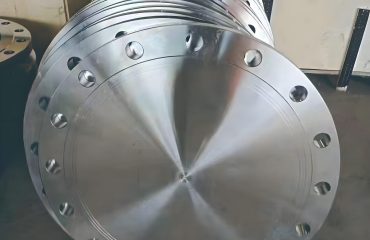
The Raised Face is the most common surface finish for SORF flanges. In Class 150 and 300, the RF height is standard at 2mm (0.06 inches), whereas in higher classes (600 through 2500), it increases to 7mm (0.25 inches). The RF serves to concentrate the bolt load onto a smaller gasket area, effectively increasing the sealing pressure.
| Class | RF Height (mm) | Surface Finish (Ra μm) | Typical Gasket |
| 150 | 2.0 | 3.2 – 6.3 | Non-Asbestos / PTFE |
| 300 | 2.0 | 3.2 – 6.3 | Spiral Wound |
| 600 | 7.0 | 3.2 – 6.3 | Spiral Wound SS316 |
| 2500 | 7.0 | 1.6 – 3.2 | Ring Type Joint (RTJ) |
2. Metallurgical Spectrum: From Carbon to Exotic Alloys
The material selection for an Abtersteel SORF flange is dictated by the “Triple Constraint”: Temperature, Pressure, and Corrosion.
The Carbon Steel Foundation (A105 & A350 LF2)
For the majority of oil and gas applications, ASTM A105 is the default forging. It is a medium-carbon steel with added Manganese for toughness. However, when the service temperature drops below $-29^\circ\text{C}$, the material undergoes a ductile-to-brittle transition. Here, A350 LF2 takes over. The “LF” signifies Low Temperature, and the material is Charpy V-Notch tested at $-46^\circ\text{C}$ to ensure it won’t shatter under thermal shock.
High-Yield and Pipeline Grades (A694)
In large-diameter 48″ pipelines, the pressure requirements often exceed the capabilities of standard A105. We turn to ASTM A694 (F42 to F70). These grades are micro-alloyed to provide higher yield strengths, allowing for thinner (and thus lighter) flange profiles in massive 48″ Series A configurations.
The Corrosion Resistance Barrier (SS & Nickel Alloys)
When the media is sour (H2S) or acidic, stainless steels like 316L or 904L are employed. But in the most aggressive chemical processing environments, we move into the realm of Super Duplex (F51/F53) and Nickel Alloys (Inconel 625, Hastelloy C276).
-
Inconel 625: Utilized for its incredible resistance to chloride-ion stress corrosion cracking.
-
Hastelloy C276: The “universal” alloy for extreme oxidizing and reducing environments.
| Material Group | Common Grades | Key Technical Attribute |
| Carbon Steel | A105, A36, A516 Gr.70 | Cost-effective, high weldability |
| LTCS | A350 LF2, LF3 | Cryogenic toughness (to $-101^\circ\text{C}$) |
| Stainless Steel | F304L, F316L, F317L | General corrosion resistance |
| Duplex | F51, F53, F60 | High strength + Pitting resistance |
| Nickel Alloys | Monel 400, Inconel 825 | Acid and Seawater resistance |
3. Scaling to the Extreme: The 48″ Series A vs. Series B
When Abtersteel manufactures 48″ (1200NB) flanges, the design philosophy shifts from ASME B16.5 to ASME B16.47. At this scale, the bolting requirements become a dominant engineering factor.
-
Series A (MSS SP-44): These are essentially “beefier” flanges. They use larger bolts and have a thicker flange body. They are designed to withstand high external bending moments—critical for long-span pipelines.
-
Series B (API 605): These are designed for compactness. They use more bolts but of a smaller diameter. They are preferred in offshore platforms or tight refinery modules where weight and space are at a premium.
For a 48″ Class 150 SORF flange, the sheer mass of the forging requires precise Heat Treatment. A105 forgings of this size must be normalized to ensure that the grain structure is uniform from the outer skin to the core. Failure to normalize can lead to “internal bursts” or “soft spots” that fail under hydrotest.
4. Welding Mechanics and Failure Preemption
The SORF flange is often criticized for having a lower fatigue life than the Weld Neck flange. This is because the stress is concentrated at the fillet welds.
Abtersteel’s Technical Recommendations for Welding:
-
Fillet Leg Length: The external fillet weld leg should be at least 1.4 times the pipe wall thickness.
-
Burn-through Prevention: On thinner stainless steel pipes, the internal weld must be carefully controlled to prevent warping the Raised Face.
-
Stress Corrosion Cracking (SCC): In stainless steel SORF flanges, the stagnant fluid in the gap between the pipe OD and flange ID can lead to crevice corrosion. In such cases, a Weld Neck flange or a “vented” SORF design might be considered.
5. Sealing and Surface Finish: The Phonographic Detail
The Raised Face of an Abtersteel flange features a Serrated Spiral Finish. If you run your fingernail across the face, you will feel the ridges. This is not a manufacturing flaw; it is a “phonographic” groove.
-
Standard Finish: 125 to 250 micro-inches $R_a$.
-
The Logic: The grooves “bite” into the gasket material, preventing it from extruding under pressure. It also creates a labyrinth path that any leaking fluid must navigate, significantly increasing the effective seal.
6. Summary of Specifications and Standards
The versatility of the SORF flange is reflected in the vast array of standards it complies with. While ASME B16.5 is the most common, Abtersteel produces components across the global spectrum:
-
European Standards: DIN 2573, 2576, 2631-2637 (ND-6 to ND-40).
-
British Standards: BS 4504, BS 10.
-
High-Pressure Specials: Class 1500 and 2500, often utilizing Ring Type Joint (RTJ) faces where a metallic ring is crushed into a groove for a “steel-to-steel” seal.
Part II: Advanced Engineering of Large-Scale SORF Interfaces
When we move beyond the standard 24-inch threshold into the realm of 48″ (1200NB) SORF flanges, the engineering requirements transition from simple piping rules to complex structural analysis. These massive components, often found in water transmission, desalination, and large-scale oil transport, demand a deeper understanding of mechanical deformation and material stability.
1. The Series A vs. Series B Paradigm in 48″ SORF Design
For 48-inch flanges, ASME B16.47 takes precedence over B16.5. The choice between Series A and Series B is one of the most critical decisions in the procurement phase at Abtersteel.
-
Series A (Large Diameter, High Load): These flanges are significantly heavier. A 48″ Class 150 Series A flange has a larger bolt circle and uses larger bolts (typically 1-1/2″ or larger). The increased thickness of the plate portion of the SORF provides higher resistance to “Flange Rotation.” When the bolts are tightened, the flange wants to bow inward; Series A’s mass resists this, preserving the gasket’s contact profile.
-
Series B (Compact, High Bolt Count): Series B uses a smaller bolt circle and more bolts (often 44 or more for a 48″ size). This design reduces the “Lever Arm” (the distance between the bolt and the gasket), which allows the flange to be thinner while still maintaining a seal. However, Series B is less capable of handling the heavy bending moments imposed by long spans of 48″ pipe.
| Parameter (48″ Class 150) | Series A (MSS SP-44) | Series B (API 605) |
| Outside Diameter | 1510 mm | 1360 mm |
| Flange Thickness | 108 mm | 54 mm |
| Bolt Quantity | 44 | 68 |
| Bolt Diameter | 1-1/2″ | 1-1/8″ |
| Weight (Approx) | 1100 kg | 450 kg |
2. Metallurgical Integrity in High-Nickel and Duplex SORFs
While carbon steel A105 is the backbone, the use of Nickel Alloys (Inconel 625, Hastelloy C276) and Duplex Steels (F51/F53) in SORF configurations introduces unique metallurgical challenges during the welding phase.
The Heat Affected Zone (HAZ) in Duplex SORFs
Duplex stainless steel (F51) relies on a 50/50 balance of austenite and ferrite. When welding an F51 SORF flange to a pipe, the cooling rate must be precisely controlled. If the weld cools too slowly, brittle intermetallic phases (like Sigma phase) can form in the HAZ. If it cools too fast, the ferrite content becomes too high, leading to reduced toughness and poor corrosion resistance.
Nickel Alloy “Hot Cracking”
High-nickel alloys like Inconel 625 are prone to “hot cracking” during the fillet welding of a SORF flange. Abtersteel utilizes low-heat-input welding techniques (such as Pulse-GMAW) to minimize the thermal stress on the flange hub. Because the SORF has an internal and external weld, the “restraint” on the metal is high, increasing the risk of cracking if the welding sequence is not balanced.
3. The Mechanics of the “Raised Face” (RF) Serrations
The Raised Face is not just a flat pedestal; it is a friction-generating surface. For SORF flanges, the surface finish is typically a Concentric or Spiral Serrated finish.
-
Spiral (Phonographic) Serrated: This is the standard for most Abtersteel SORF flanges. It is produced by a continuous spiral groove with a 90-degree “V” tool. The spiral creates a labyrinthine path that makes it extremely difficult for a leak to propagate.
-
Concentric Serrated: Preferred in gas applications or when using very thin gaskets. Since there is no continuous path from the ID to the OD, it offers a slight theoretical advantage in preventing “weepage” of gas molecules.
Surface Roughness (Ra):
For standard gaskets, a roughness of 3.2 to 6.3 $\mu$m is required. If the finish is too smooth (e.g., $1.6\text{ }\mu\text{m}$), the gasket can be “pushed out” by the internal pressure (Gasket Blowout). The serrations act as microscopic “teeth” that lock the gasket in place.
4. Pressure-Temperature Ratings: The A105 vs. SS316L Trade-off
One of the most complex aspects of SORF selection is understanding the P-T Rating across different materials. A Class 150 flange does not mean 150 psi in all conditions.
As the temperature rises, the allowable pressure drops. However, the rate of drop depends on the material’s Elastic Modulus and Yield Strength at temperature.
-
A105 (Carbon Steel): Maintains its strength well up to $400^\circ\text{C}$, but is limited by oxidation.
-
F316L (Stainless Steel): Has a lower pressure rating than A105 at room temperature but maintains its toughness much better at cryogenic temperatures ($-196^\circ\text{C}$).
| Temperature (∘C) | A105 (Class 300) | F316L (Class 300) |
| -29 to 38 | 51.1 Bar | 41.4 Bar |
| 100 | 46.6 Bar | 34.8 Bar |
| 200 | 43.8 Bar | 29.2 Bar |
| 300 | 39.8 Bar | 25.8 Bar |
| 400 | 34.7 Bar | 23.3 Bar |
Note: This table clearly shows that an Abtersteel A105 flange is significantly stronger than its 316L counterpart in high-pressure steam service, though it lacks the corrosion resistance.
5. Installation Dynamics: The “Cold Spring” and Alignment
A major advantage of the SORF flange in the field is its ability to compensate for Piping Misalignment.
With a Weld Neck flange, the pipe and flange must be perfectly square before welding. With a SORF, the “slip” allows for a small amount of play. However, Abtersteel’s technical advisors warn against using this play to “force” an alignment (known as Cold Springing).
If the flange is welded while under stress, the internal fillet weld will be under a permanent shear load. When the internal pressure and thermal expansion are added, the weld can fail prematurely through Stress Rupture.
6. Summary of Specialized SORF Variants
-
Ring Type Joint (RTJ) SORF: Used in Class 600 and above. Instead of a Raised Face, a deep groove is machined into the flange. A hexagonal or oval metal ring is placed in the groove. This provides a “steel-to-steel” seal that is virtually blowout-proof.
-
LF2 Low-Temp SORF: Specifically for the LNG industry, ensuring the flange does not become brittle at $-46^\circ\text{C}$.
-
F91 Alloy SORF: Used in high-pressure power plant piping (Chromium-Molybdenum steel) to resist creep at $600^\circ\text{C}$.
Conclusion: The Strategic Verdict on SORF
The Slip-On Raised Face flange is an engineering compromise that leans toward operational efficiency. It provides a robust, weldable, and easily aligned connection point for virtually any material grade—from humble A36 carbon steel to the most exotic Titanium or Inconel alloys.
At Abtersteel, the technical depth of our SORF production lies in the control of the forging process and the precision of the Raised Face finish. While the Weld Neck may be the “king” of high-fatigue environments, the SORF remains the “engine room” of the piping world—reliable, cost-effective, and adaptable to sizes ranging from 1/2″ to the massive 48″ arteries of global energy transport.
You must be logged in to post a comment.