
Technical Metrics & Material Attributes
Its yield strength is substantially higher than that of common austenitic grades such as 316L.
The higher proof stress can allow thinner wall schedules where the design calculation permits.
The PREN value is commonly used to assess resistance to localized pitting and crevice corrosion.
Commonly selected for sour service, offshore systems, and demanding chemical-service piping.
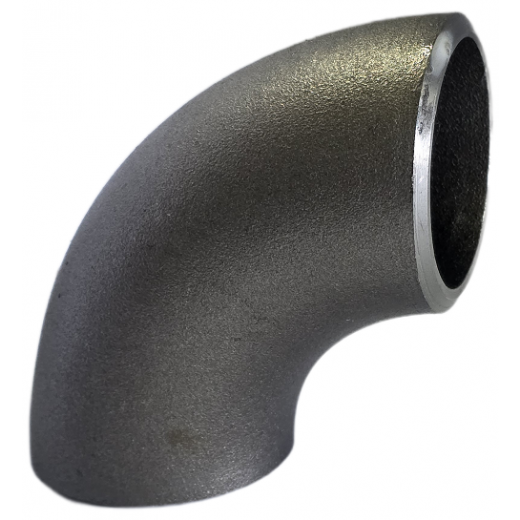
Material Overview: ASTM A815 WPS UNS S32750 Super Duplex Elbows
ASTM A815 WPS UNS S32750 is a wrought ferritic/austenitic super duplex stainless steel fitting grade used where strength and corrosion resistance are both important. It is used in marine, petrochemical, subsea, and chemical-processing service where conventional stainless steels may not provide enough margin, UNS S32750 (commonly known as 2507 Super Duplex or EN 1.4410) offers a balanced 50/50 dual-phase microstructure consisting of roughly equal proportions of austenite and ferrite. The duplex structure combines relatively high yield strength with good resistance to chloride-related stress corrosion cracking (SCC), while retaining useful toughness when the phase balance is properly controlled.
The designation WPS in ASTM A815 indicates wrought grade seamless piping fittings manufactured to strict ASME B16.9 and MSS SP-43 requirements. These elbows, available in both Long Radius (LR, R=1.5D) and Short Radius (SR, R=1.0D) configurations, are used to change flow direction in high-pressure piping networks. Whether utilized in deepwater offshore oil rigs, reverse osmosis seawater desalination plants, aggressive sour gas scrubbers, or high-purity chemical reactors, ASTM A815 WPS UNS S32750 elbows are intended for service involving cyclic loading, temperature changes, and corrosive process fluids.
Key Material Classifications Covered by Specification ASTM A815:
- Class WP-S: Wrought seamless fittings manufactured from seamless pipe, tube, or wrought stock.
- Class WP-W: Wrought fittings containing welds where the filler metal has been added and non-destructively inspected via radiography (RT).
- Class WP-WX: Wrought welded fittings where all welds are 100% radiographed per ASME Boiler and Pressure Vessel Code.
- Class WP-WU: Wrought fittings where all welds are 100% examined using ultrasonic testing (UT).
Chemical Composition Limits (%) — UNS S32750 vs Duplex Family
Elemental limits are controlled to support corrosion resistance and to reduce the risk of undesirable intermetallic phases such as sigma (σ) and chi (χ).
| Grade / UNS | Carbon (C) | Cr | Ni | Mo | N | Cu | Mn (Max) | Si (Max) | P / S (Max) |
|---|---|---|---|---|---|---|---|---|---|
| WPS S32750 (2507) | ≤ 0.030 | 24.0 – 26.0 | 6.0 – 8.0 | 3.0 – 5.0 | 0.24 – 0.32 | ≤ 0.50 | 1.20 | 0.80 | 0.035 / 0.020 |
| WPS S31803 (2205) | ≤ 0.030 | 21.0 – 23.0 | 4.5 – 6.5 | 2.5 – 3.5 | 0.08 – 0.20 | — | 2.00 | 1.00 | 0.030 / 0.020 |
| WPS S32202 (2202) | ≤ 0.030 | 21.5 – 24.0 | 1.0 – 2.8 | 0.45 max | 0.18 – 0.26 | — | 2.00 | 1.00 | 0.040 / 0.010 |
| WPS S32760 (Zeron 100) | ≤ 0.030 | 24.0 – 26.0 | 6.0 – 8.0 | 3.0 – 4.0 | 0.20 – 0.30 | 0.50 – 1.00 | 1.00 | 1.00 | 0.030 / 0.010 |
* Note: UNS S32750 contains deliberate additions of Nitrogen (0.24–0.32%) to significantly boost pitting resistance, promote rapid intergranular re-austenitization during heat treatment, and increase mechanical yield strength.
Mechanical & Structural Performance Data
The ferrite-austenite balance gives S32750 high tensile and yield strength, useful low-temperature toughness, and good resistance to erosion-corrosion. When compared to standard 300 series stainless steel or conventional lean duplex alloys, S32750 permits engineers to specify thinner wall schedules (e.g., SCH 10S vs SCH 40S) without sacrificing structural safety margins.
Where permitted by the applicable ASME B31.3 design conditions, the higher allowable stress can reduce required wall thickness and system weight.
ASTM A815 S32750 Mechanical Limits
| Mechanical Parameter | ASTM A815 Standard Limit |
|---|---|
| Tensile Strength, min (MPa / ksi) | 800 – 965 / [116 – 140] |
| Yield Strength (0.2% offset), min | 550 MPa / [80 ksi] |
| Elongation in 2 in. (50 mm), min % | 15.0 % |
| Hardness, Brinell (HBW), max | 310 HBW max |
| Hardness, Rockwell C (HRC), max | 32 HRC max |
| Charpy V-Notch Impact Energy (-40°C) | ≥ 80 Joules (Average) |
Corrosion Resistance Physics & PREN Formula Calculations
Pitting and crevice-corrosion resistance of Super Duplex UNS S32750 is commonly discussed using the Pitting Resistance Equivalent Number (PREN). A higher PREN generally indicates greater resistance to localized passive-film breakdown in chloride-containing service.
Pitting & Crevice Corrosion
With a minimum PREN of 42, S32750 elbows are generally selected for chlorinated seawater service when the temperature and chloride exposure are within the design limits.
Stress Corrosion Cracking (SCC)
Compared with many austenitic grades, the duplex structure provides better resistance to chloride SCC. Actual performance in H2S service still depends on temperature, chloride level, stress, and the applicable materials standard.
Erosion-Corrosion
High material hardness combined with superior dynamic passive film regeneration helps the elbows withstand erosion-corrosion in services containing suspended solids, including some subsea slurry applications.
Long Radius (LR) vs Short Radius (SR) Duplex Elbows
The choice between Long Radius (R = 1.5D) and Short Radius (R = 1.0D) is normally based on pressure loss, flow conditions, pigging, and available installation space.
Long Radius (LR) Elbow (R = 1.5D)
- Center-to-End Distance: 1.5 times the nominal pipe diameter (A = 1.5 × NPS).
- Frictional Head Loss: The larger bend radius generally produces a smoother change in direction and lower pressure loss.
- Pigging Capability: A common choice for lines that require conventional or intelligent pigging.
- Erosion Resistance: The larger radius can reduce local flow disturbance and may help limit erosion at the bend.
- Primary Applications: Long-distance cross-country oil pipelines, offshore subsea risers, process chemical lines.
Short Radius (SR) Elbow (R = 1.0D)
- Center-to-End Distance: Equal to the nominal pipe diameter (A = 1.0 × NPS).
- Frictional Head Loss: Higher directional change resistance and slightly elevated turbulence.
- Pigging Capability: Less suitable where the piping system requires passage of rigid inspection pigs.
- Compact Layout: Useful where the available layout space does not allow a long-radius elbow.
- Primary Applications: Subsea skid packages, compact FPSO topside modules, marine engine rooms, skid systems.
ASME B16.9 90° Long Radius (LR) Elbow Dimensions & Weight Chart
Reference dimensions for ASTM A815 WPS UNS S32750 butt-weld 90-degree LR elbows (1/2″ to 24″).
| Nominal Size (NPS) | Outside Diameter (OD) [mm] | Center to End (A) [mm] | Wall Thickness (SCH 10S) [mm] | Wall Thickness (SCH 40S) [mm] | Wall Thickness (SCH 80S) [mm] | Approx. Weight (SCH 40S) [kg] |
|---|---|---|---|---|---|---|
| 1/2″ (DN15) | 21.3 | 38.0 | 2.11 | 2.77 | 3.73 | 0.08 |
| 3/4″ (DN20) | 26.7 | 38.0 | 2.11 | 2.87 | 3.91 | 0.11 |
| 1″ (DN25) | 33.4 | 38.0 | 2.77 | 3.38 | 4.55 | 0.16 |
| 1-1/2″ (DN40) | 48.3 | 57.0 | 2.77 | 3.68 | 5.08 | 0.42 |
| 2″ (DN50) | 60.3 | 76.0 | 2.77 | 3.91 | 5.54 | 0.78 |
| 3″ (DN80) | 88.9 | 114.0 | 3.05 | 5.49 | 7.62 | 2.15 |
| 4″ (DN100) | 114.3 | 152.0 | 3.05 | 6.02 | 8.56 | 4.12 |
| 6″ (DN150) | 168.3 | 229.0 | 3.40 | 7.11 | 10.97 | 11.20 |
| 8″ (DN200) | 219.1 | 305.0 | 3.76 | 8.18 | 12.70 | 23.50 |
| 10″ (DN250) | 273.0 | 381.0 | 4.19 | 9.27 | 12.70 | 41.80 |
| 12″ (DN300) | 323.8 | 457.0 | 4.57 | 9.52 | 12.70 | 64.50 |
ASME B16.9 / MSS SP-43 90° Short Radius (SR) Elbow Dimensions
Reference dimensions and weights for compact-radius Super Duplex 2507 elbows (R = 1.0D).
| NPS Size | Outside Diameter (OD) [mm] | Center-to-End SR (A) [mm] | SCH 10S Wall [mm] | SCH 40S Wall [mm] | Approx. Weight (SCH 80S) [kg] |
|---|---|---|---|---|---|
| 1″ (DN25) | 33.4 | 25.4 | 2.77 | 3.38 | 0.14 |
| 1-1/2″ (DN40) | 48.3 | 38.1 | 2.77 | 3.68 | 0.35 |
| 2″ (DN50) | 60.3 | 50.8 | 2.77 | 3.91 | 0.65 |
| 3″ (DN80) | 88.9 | 76.2 | 3.05 | 5.49 | 1.80 |
| 4″ (DN100) | 114.3 | 101.6 | 3.05 | 6.02 | 3.40 |
| 6″ (DN150) | 168.3 | 152.4 | 3.40 | 7.11 | 9.80 |
| 8″ (DN200) | 219.1 | 203.2 | 3.76 | 8.18 | 19.50 |
Critical Heat Treatment & Microstructural Phase Balance
The properties of ASTM A815 WPS UNS S32750 elbows depend on maintaining an appropriate 40%–60% Ferrite / 60%–40% Austenite phase ratio. Unsuitable heat treatment can promote intermetallic precipitation, including the embrittling Sigma Phase (σ) and Chi Phase (χ), which can reduce impact toughness and localized-corrosion resistance.
| Grade / ASTM | Solution Annealing Temperature | Cooling / Quenching Method | Target Ferrite Content |
|---|---|---|---|
| WPS S32750 (2507) | 1025°C – 1125°C [1920°F – 2060°F] | Rapid Water Quench (below 300°C within seconds) | 40% – 60% Ferrite (E562 Point Count) |
| WPS S31803 (2205) | 1020°C – 1100°C [1870°F – 2010°F] | Water Quench or Rapid Air Cool | 40% – 60% Ferrite |
| WPS S32202 (2202) | 1020°C – 1080°C [1870°F – 1975°F] | Water Quench or Forced Air Quench | 45% – 55% Ferrite |
Quench Rate: Cooling through the critical temperature range must be fast enough to limit intermetallic precipitation. The selected quench practice is intended to retain the required phase balance and mechanical properties.
Manufacturing Workflows for Seamless & Welded Elbows
Typical production combines hot forming, hydraulic forming where applicable, end machining, surface treatment, and non-destructive examination.
Hot Mandrel Forming
For seamless fittings, the pipe or hollow stock is heated and formed over a mandrel so that the bend radius, wall distribution, and roundness stay within the required tolerances.
Plate Pressing & Welding
For larger fittings (>24″), plate may be formed into shells, prepared at the seams, and welded with a suitable super-duplex filler such as ER2594.
Full Solution Annealing
After forming, the elbows are solution annealed within the specified temperature range and rapidly cooled to restore the required phase balance.
Beveling & Surface Pickling
The ends are machined to the required ASME B16.25 bevel geometry. Pickling and passivation are then used to remove heat tint and restore a clean passive surface.
Welding Specification & Consumables Guidelines for S32750
Welding ASTM A815 WPS S32750 elbows requires controlled heat input and interpass temperature. Excessively rapid cooling can shift the HAZ phase balance, while excessive heat input or prolonged exposure can increase the risk of secondary phases.
| Welding Process | AWS Filler Metal Specification | Recommended Heat Input | Shielding / Backing Gas |
|---|---|---|---|
| GTAW (TIG) | AWS A5.9 ER2594 (Over-alloyed Ni ~ 9%) | 0.2 – 1.5 kJ/mm | Pure Ar or Ar + 2% N2 / Ar + 30% He + 2% N2 |
| SMAW (Stick) | AWS A5.4 E2594-16 / E2594-17 | 0.5 – 1.5 kJ/mm | N/A (Flux coated) |
| GMAW (MIG) | AWS A5.9 ER2594 Wire | 0.5 – 1.2 kJ/mm | Ar + 2% N2 or Ar + 30% He + 2% N2 |
| SAW (Submerged Arc) | AWS A5.9 ER2594 Wire + Basic Flux | 0.8 – 1.8 kJ/mm | Neutral / Basic Welding Flux |
Maximum interpass temperature must be strictly limited to 100°C (212°F) during all pass sequences to prevent precipitation of secondary austenite and embrittling phases.
Quality Control & Testing Protocols
The inspection plan for ASTM A815 WPS UNS S32750 elbows normally combines material verification, dimensional checks, and the non-destructive or destructive tests specified by the purchase order and applicable standard.
1. PMI Testing
Positive Material Identification (PMI) by XRF or OES can be used to confirm the principal alloying elements and heat traceability.
2. Corrosion Testing
Where specified, ASTM G48 Method A testing can be used to evaluate resistance to ferric-chloride pitting and crevice corrosion.
3. Microstructure & Ferrite
Metallographic examination, including ferrite measurement where required, is used to check phase balance and identify undesirable intermetallic phases.
4. Radiographic (RT) / UT
Welded classes may require radiographic or ultrasonic examination according to the applicable specification, purchase order, and inspection plan.
International Standards & Equivalent Designations Matrix
| Standard Organization | Standard Code | Description / Fitting Type |
|---|---|---|
| ASTM Standard | ASTM A815 / A815M | Standard Specification for Wrought Ferritic, Ferritic/Austenitic, and Martensitic Stainless Steel Piping Fittings |
| ASME Standard | ASME B16.9 | Factory-Made Wrought Buttwelding Fittings (NPS 1/2 through NPS 48) |
| MSS Standard | MSS SP-43 | Wrought and Fabricated Butt-Welding Fittings for Low Pressure, Corrosion Resistant Applications |
| MSS Standard | MSS SP-97 | Integrally Reinforced Forged Branch Outlet Fittings — Socket Welding, Threaded, and Buttwelding Ends |
| European Norm | EN 10253-4 / EN 10088-3 | Butt-welding pipe fittings – Wrought austenitic and austenitic-ferritic (duplex) stainless steels |
| NACE Standard | NACE MR0175 / ISO 15156 | Petroleum and natural gas industries — Materials for use in H2S-containing environments in oil and gas production |
Key Industrial Applications for Super Duplex S32750 Elbows
Typical service areas include high-stress and corrosive industrial systems.
Offshore Oil & Gas Topsides
Used in subsea manifolds, Christmas trees, flowlines, risers, and firewater systems where seawater exposure and sour-service conditions place demanding requirements on corrosion resistance.
Seawater Desalination Plants
Used in reverse-osmosis pump manifolds, brine headers, and energy-recovery systems handling concentrated saline water.
Chemical Processing & Acid Plants
Used in selected heat-exchanger, reboiler, and acid-service piping where the corrosion conditions exceed the practical limits of common austenitic grades.
Dimensional Tolerances per ASME B16.9 / MSS SP-43
| Nominal Pipe Size (NPS) | Off Angle Tolerance (Q) | Off Plane Tolerance (P) | Center-to-End Tolerance | Inside Diameter at End |
|---|---|---|---|---|
| 1/2″ to 2-1/2″ | ± 1 mm | ± 2 mm | ± 2.0 mm | +0.8 mm / -0.8 mm |
| 3″ to 3-1/2″ | ± 2 mm | ± 3 mm | ± 2.0 mm | +1.6 mm / -1.6 mm |
| 4″ | ± 2 mm | ± 3 mm | ± 2.0 mm | +1.6 mm / -1.6 mm |
| 5″ to 8″ | ± 3 mm | ± 5 mm | ± 2.0 mm | +1.6 mm / -1.6 mm |
| 10″ to 18″ | ± 4 mm | ± 6 mm | ± 3.0 mm | +3.2 mm / -1.6 mm |
| 20″ to 24″ | ± 5 mm | ± 10 mm | ± 3.0 mm | +4.8 mm / -1.6 mm |
Export Packaging, Product Marking & Quality Certification
For export shipment, the fittings are protected against contamination, moisture, and handling damage, with identification marks retained for heat and product traceability.
Standard Marking Specification
Continuous die-stamped marking on each elbow includes: Manufacturer Name/Logo, Standard Code (ASTM A815 WPS S32750), Pipe Size, Wall Thickness/Schedule, Heat Number for 100% mill traceability.
Seaworthy Fumigation-Free Wooden Cases
Fittings are protected with end plastic caps, individually wrapped in moisture-proof plastic film, and packed into heavy-duty fumigation-free plywood boxes with steel strap reinforcement.
EN 10204 3.1 & 3.2 Mill Certificates
Material Test Reports can be supplied to EN 10204 3.1, with third-party inspection available when required by the order.
Procurement Quick Reference
ASTM A815 WPS UNS S32750 Super Duplex Elbow Data Card
Quick reference for engineering, procurement, and piping design work.

You must be logged in to post a comment.